__________________________________________________________________

The Renewable Energy Institute is a Non-Profit company that is Changing The Way The World Makes and Uses Energy by Providing Research & Development, Funding and Resources That Create Pollution Free Power, Carbon Free Energy & Renewable Energy Technologies. We fund important research that leading professors, grad students and universities are conducting that will make America energy independent and end our dependence on foreign fossil fuels. The Renewable Energy Institute is available to perform Renewable Energy Feasibility studies and Front-end engineering design services - including solar co/trigeneration plants, geothermal power plants, concentrating solar power plants, and biodiesel/biomethane/synthesis gas fueled cogeneration or trigeneration power plants.  The fee for this is dependent on a number of factors. Call or email us for more information.

The Renewable Energy Institute authorized the Renewable Energy Institute to the first State Chapter for the State of Florida in 2009.  The REI is planning to open new locations in several states in 2010. 

The Renewable Energy Institute is the Publisher for many renewable energy websites and makes some of these sites available for advertising. Contact the Renewable Energy Institute for more information regarding more information and advertising rates by sending email to:  info@RenewableEnergyInstitute.org regarding the specific website.


To advertise on this site, call/email the Renewable Energy Institute

info@RenewableEnergyInstitute.org


ANNOUNCING THE FORMATION OF:

Wind Energy Institute
www.WindEnergyInstitute.com

&

International Institute for Climate Solutions
www.InstituteForClimateSolutions.com


The members of the Board of Directors of the Renewable Energy Institute ("REI") have formed and founded the International Institute for Climate Solutions, the Wind Energy Institute and we are now forming the Biomass Energy Institute. The International Institute for Climate Solutions and Wind Energy Institute have been incorporated as  non-profit Texas companies. The Biomass Energy Institute will also be a Texas non-profit company.

Like the Renewable Energy Institute, one of our first objectives is the creation of our Scientific Advisory Board which will be a "Who's Who" of professors, universities and researchers that are involved with climate change and seeking to provide solutions for reducing Greenhouse Gas Emissions. Watch for new developments of the International Institute for Climate Solutions and Wind Energy Institute at the following new websites:

www.WindEnergyInstitute.com

www.InstituteForClimateSolutions.com


_____________________________________________________________________


Vision Statement for 
the Renewable Energy Institute

To end America's dependence on unsustainable sources of energy, lead and formulate public policy that promotes greater use of renewable energy, and develop strategic partners that share and advance the goal of making the United States energy independent.

Mission Statement for 
the Renewable Energy Institute

To educate the public stakeholders that include residential, commercial, industrial and governmental organizations who are consumers of energy the many benefits and uses of renewable energy and to promote the expanded use of renewable energy technologies in the United States and around the world.


Goals and Objectives of 
the Renewable Energy Institute

The specific goals and objectives of the Renewable Energy Institute, a non-profit company shall be:

1. To expand the use of renewable energy technologies in the United States and around the world.

2. To end America's dependence on unstable, unsustainable foreign sources of energy, and make the United States energy independent.

3. To lead and formulate public policy that promotes greater use of renewable energy.

4. To lead the research and development of new renewable energy technologies that lead to patents and the ability to license the renewable energy technologies we develop and invest.

5. To coordinate the research and development of renewable energy between universities so as to minimize redundancy and maximize results.

6. To facilitate and promote dialog between universities and professors in the free flow of research to enhance results and breakthroughs in renewable energy research and development. 

7. To educate and inform the public, including stakeholders that include residential, commercial, industrial and governmental organizations who are consumers of power and energy, the many benefits and uses of renewable energy.

8.  The Renewable Energy Institute will promote higher energy and electric power efficiencies and renewable energy technologies including; Anaerobic Digesters, Automated Demand Response, Biodiesel, Biomass Gasification, BioMethane and BioMethane Recovery, Cogeneration, Concentrating Solar Power, Demand Side Management, Dispersed Generation, Distributed Generation (onsite power generation), Fuel Cells, Geothermal, Hydrogen, Landfill Gas to Energy, Ocean and Tidal energy, Supply Side Management, Thermal Gasification, Trigeneration, Waste to Energy, Waste To Watts and to promote the use of energy crops and oilseed crops for producing biofuels and related technologies whenever a renewable fuel may be used in an internal combustion engine or gas turbine to produce clean power and energy. The Renewable Energy Institute will promote Carbon Dioxide Sequestration technologies, also called Carbon Capture and Sequestration.

9. To help farmers and growers in determining the optimum energy crops and oilseed crops they should consider for their specific locations, soils, climate and energy markets.

10. To adopt a goal of providing the U.S. with 50% of its' power and energy requirements from renewable energy sources by 2025, and 75% by 2050.  Texas will lead the way with a goal of 50% of its' power and energy requirements from renewable energy sources by 2020, and 75% by 2040.

11. To seek funding, investments and donations for the REI from concerned citizens, organizations and companies that will fund the REI's grants, research and development.

12. To seek and develop strategic partners/partnerships that share and advance our common goals. 

13. To seek out qualified companies and people that want to utilize our products and services under our license.

14. To provide Engineering Feasibility and Economic Analysis studies for customers - through a separate entity affiliated with the Renewable Energy Institute.

15. To develop renewable energy projects on behalf of customers - through a separate entity affiliated with the Renewable Energy Institute.
 
16. To remain committed as a trusted supplier of research, development and technologies and be committed as a "vendor-neutral" resource of information - until such time we identify "optimum" companies, products and/or technologies. 

17. To promote and integrate the use of renewable energy technologies in creating "sustainable communities," "renewable energy districts," and "green buildings."   
 
18. To be committed to ending global warming, eliminating carbon dioxide emissions and greenhouse gas emissions from fossil fuels, and advance technologies such as carbon dioxide sequestration to end global climate change. 
 
The Renewable Energy Institute will fund research and development of all renewable energy technologies, as well as provide leadership in the areas of "Pollution Free Power," "Carbon Free Energy," and "green tags" also known as a Renewable Energy Credit. 

The Renewable Energy Institute will also conduct testing of renewable energy technologies, that compare various manufacturers products' and determines which products have the highest efficiencies, and fastest returns on investment (ROI). And, the Renewable Energy Institute will conduct "vendor-neutral" Engineering Feasibility and Economic Analysis, for specific renewable energy projects, for our customers, to determine the best technologies, and best equipment, for each new renewable energy project. 

Please contact M o n t y  G o o d e l l, President, Executive Director and Founder of the Renewable Energy Institute by email or phone to learn more about upcoming meeting that will be open to the public.  Tel. (832)  758 - 0027

___________________________________________________________________

Greenhouse Gas Emissions Linked to 
the Loss of a "Few" Polar Bears

Photo courtesy of Alaska Image Library. U.S. Fish and Wildlife Service


______________________________________________________________

“spending hundreds and hundreds and hundreds of billions of dollars every year for oil, much of it from the Middle East, is just about the single stupidest thing that modern society could possibly do. It’s very difficult to think of anything more idiotic then that.”   R. James Woolsey, Jr., former Director of the CIA

Price of Addiction
###
to Foreign Oil


About the Renewable Energy Institute
, Climate Science,
Tax-payer Subsidies for Fossil Fuel & Nuclear Industries,
Peak Oil & America's Clear and Present Danger


Monty Goodell, MBA
Founder and Chairman
Renewable Energy Institute

The Renewable Energy Institute (REI) does not take a stand in the debate on global warming, and if there is global warming, is it "anthropogenic" or is it caused by the sun, or the sun's normal cycles.  Or, if there is " climate change," is it " global cooling" caused by the water vapor in the atmosphere?

At the Renewable Energy Institute, we are waiting for the "true" scientists who doing the real research, to provide us with the science and answers critically needed to formulate correct policy - and not the phony " scientists" who are following politically-motivated and profit-driven agendas of the United Nations and government leaders. These phony scientists are not interested in conducting real scientific research.  Their very livelihoods are dependent on the government grants to fund their phony research that have pre-determined conclusions before and "research" is conducted.  

Political-interference by governments, governmental agencies, and bureaucrats that hand out billions of tax-payers dollars to phony scientists to conduct "junk science" and research,  expect the conclusions that supports anthropogenic global warming, or climate change. 

When scientists conclude in their research that they find no evidence of anthropogenic climate change or global warming, they are summarily dismissed, and black-balled from their communities and colleagues, and never again receive funding or grants.  Grants and funding by government bureaucrats with politically-driven agendas to "scientists" expecting their pre-determined results and conclusions supporting anthropogenic global warming must stop.

According to the International Energy Agency (IEA), in 2007

  • the solar industry received $198 million in subsidies.

  • the oil and natural gas industry collected $2.1 Billion in tax-payer subsidies.

  • the coal industry coal received $3.2 Billion in tax-payer subsidies.

And since 1960:

  • the nuclear industry has received nearly $70 billion in tax-payer incentives and tax-payer subsidies. 

Taxpayers have bankrolled the oil and gas industry, and the coal industry for 100 years now, and the nuclear industry for 50 years, to keep these dirty fuels and energy "cheap." Take away the tax-payer incentives and tax dollars, and we believe the real cost of gasoline, would be similar to the gasoline cost in Europe - $7.00 - $8.00/gallon!

In the meantime, our U.S. Military is spending billions of tax-payer dollars each year protecting the Straits of Hormuz where much of the world's crude oil is produced and shipped through the straits' international shipping lanes.  Each day, hundreds of "very large crude carriers" pass through the Straits of Hormuz carrying oil from OPEC and the Middle-East to the U.S. and many other countries. 

Isn't it time we take some of the tax-payer dollars supporting the nuclear, coal and oil and gas industries, and start incentivizing clean, renewable energy technologies that don't pollute or harm the environment in any way?  Isn't it time that America ends its reliance on non-sustainable energy sources and stop over $1 billion every day, to oil suppliers from foreign countries, and start putting this money in "solar on every rooftop?!?

Mercury Emissions from Coal Fired Power Plants Far More Harmful to the Planet and People than Greenhouse Gas Emissions

Regarding the harm being caused to our planet from energy use, far more harm is being done to the planet, as well as to people and plants and animals, particularly fish, from the mercury emissions from coal fired power plants than from the coal fired power plants' greenhouse gas emissions.  We surmise that if any polar bears have died as a result of an environmental problem, it was more likely from the high levels of mercury in their food chain, than from greenhouse gas emissions

The Renewable Energy Institute is supporting and advancing renewable energy technologies, as well as reducing and eliminating greenhouse gas emissions and the fossil-fuel problems related to America's oil addiction and ending our dependence on foreign oil.  The renewable energy technologies we support are already deemed to be economic, viable and practical. Solutions such as Solar Trigeneration energy systems (see www.SolarTrigeneration.com for more information) for any kind of facility or building - office buildings, shopping centers, data centers, university campuses, etc. 

Since 2003, a Solar Trigeneration energy system has been providing 100% of the power and energy for a 5,300 sq. ft. office building near downtown Los Angeles, and doing so without any connection to the electric grid, whether its 12 noon or 12 midnite!  

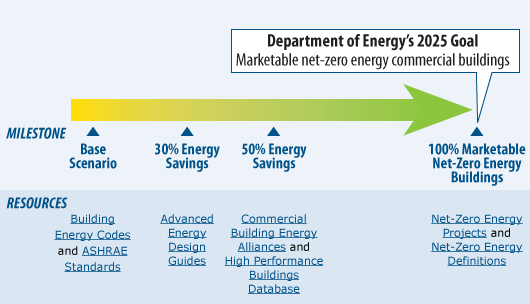
The Renewable Energy Institute is also involved in research and advocacy of "Net Zero Energy" (see: www.NetZeroEnergy.com for more information) and "Net Zero Energy Buildings" (see:  www.NetZeroEnergyBuildings.com for more information).  Net Zero Energy Buildings generate as much (or more) energy than they use, and export their excess power to the grid, which we believe needs to be updated into a "Transmission Superhighway."

Climate Change, Global Warming or Global Cooling?

The past 10 years indicates the opposite of "global warming" has occurred - that the "Earths Fever" has and that global cooling has taken place. 

Weather, on a daily basis, or even an annual basis, is not climate, and climate is not weather. 

"Climate change" is always taking place, from one day to the next, and one week to the next, as well as one year to the next. The planet's climate is an ever-evolving, changing and dynamic process.  

Again, researchers and scientists need to refrain from being political, and stay out of politics, and politicians need to stay out of the way of the scientists and researchers, and let them do their work.  Politicians, government leaders and bureaucrats scientists need true and accurate data and climate research from scientists that do not have a political agenda.

In the meantime, as there may still be 30 years of research before there are conclusive answers concerning anthropogenic climate change, can we "risk" 30 years of our children and grand children's future, should there is a link between climate change and greenhouse gas emissions?  Should we not err on the side of caution?

Hubbert's Peak Oil Predictions Now Proving True?

Marion King Hubbert was a geologist and scientist who worked at Shell Oil company's research lab in Houston, Texas.  Hubbert made several important contributions to geology, geophysics and petroleum geology.  Hubbert is most recognized for the "Hubbert Curve" and " Hubbert Peak Theory" which is now referred to as " Peak Oil. 

Hubbert's life work determined that the world has a finite amount of petroleum that can be produced.  (Similarly, there is a finite amount of coal.) Many scientists and engineers believe we have reached Hubbert's "peak oil" limit.  Hubbert's espouses that when 50% of domestic crude oil production has been reached, that there will be such significant upward demand on prices of the limited supplies of oil production, that the U.S. economy will experience severe economic, social, and political turmoil.

Hubbert's Peak Oil predictions have proven to be true and this is validated as the U.S. in the early 1970's produced about 60% of its' oil demand and imported 40%.  That equation has flipped since then, because our domestic oil production has been on the decline since 1970, so now, due to our declining domestic oil production, we have to import 60% of our oil supplies, to meet our country's oil/energy demands.

The Next Oil Shock Could be the "mother" of All Oil Shocks

How severe our economic calamity and next "oil shock" will depend upon a number of factors, including when this occurs, as well as the following:

1.  the dependence of the individual country upon its own crude oil production to meet its energy needs and to subsidize consumer imports; 

2.  the rate of relative decline in crude oil production; 

3.  the degree of difficulty encountered in replacing missing energy inputs; 

4.  the degree to which our country had prepared in advance for this inevitable geological and economic calamity.

Examples of past "oil shocks" and the economic and political calamities that followed:

United States: Our peak crude oil production of domestic oil occurred in 1970; the first "oil shock" and oil crisis followed in 1973 with the Arab/OPEC Oil Embargo.

Iran: Their peak crude oil production occurred in 1974; They had their islamic revolution 1979 that overturned government and replaced it with radical islam.

Soviet Union: Their peak crude oil production was in 1989; what happened next? 
Their country disintegrated and the collapse of the Soviet Union followed in 1991. 

Indonesia: Their peak crude oil production was in 1991; their financial and government crisis followed in 1997.

Iraq: Iraq's crude oil production was in 1989; they then invaded Kuwait (for their oil) in 1991.

Using Mr. Hubbert's predictions, that beginning around 2000  we would see peak (global) oil production, then, if the country's not weaning themselves off of their oil addiction, and had not begun making the switch to renewable energy, that the negative economic and political calamities would soon follow, including ever-increasing prices of energy that is from fossil fuels. 

Now is the time to begin weaning ourselves off of fossil fuels and making the transition to and increasing the use of renewable energy. If you don't believe in climate change, or global warming, GREAT! Join us in the switch to renewable energy and a fossil-free economy!

America's "Clear and Present Danger"

America Has INCREASED its' Dependence on Foreign 
Sources of Energy by 50% Since 1973.

America is even more "addicted" to foreign oil today, than we were in 1973 - 1974 when OPEC, Saudi Arabia and other suppliers from the Middle-East  stopped selling us their fossil fuels, and created a significant blow to our economy.

According to the CIA Fact Book, Every Day, the U.S.:

PRODUCES:      7,460,000 bbls of oil (within its borders)

CONSUMES:   20,800,000 bbls of oil


This Means that 65% of America's Energy Supplies are Now Imported from Suppliers from Foreign Countries.  

Simply put, about 65% of the gasoline in your car's gas tank, comes from a foreign country.

EVERY day, the U.S. must IMPORT over 13 million bbls of oil from foreign countries and foreign suppliers to meet demand. 


At $80/barrel of oil, this also means that $1,040,000,000.00 American Dollars leave our country, EVERY DAY, to foreign countries/suppliers of our fossil fuels, to pay for the energy we need. 


That's $1 Billion EVERY day leaving our economy, and going to support a foreign country's economy. 


Talk about our foreign trade deficit..... nearly $400 Billion each year, leaves our country to pay for our oil addiction and the energy we need.  To be exact, that's $379,600,000,000.00 American Dollars.

This is NOT acceptable.

America needs to quickly transition to Energy Independence. 

Renewable Energy is the Only Way America Can Achieve Energy Independence. 

Millions of new and sustainable American jobs would be created here at home, if we would end our addiction to foreign fossil fuels, and quickly transition to an economy based on renewable energy and renewable fuels, produced here in the U.S.A. 

The good news is that today, America already has all of the Renewable Energy Resources and Renewable Energy Technologies needed to make American Energy Independence a reality. 


Green Energy

According to Monty Goodell, Founder and Chairman of the Renewable Energy Institute, "our increased dependence and reliance on foreign energy supplies represents a Clear and Present Danger to our national security, our economy, and the lives and livelihood of every American. Energy - including the energy we use from imported fossil fuels, is the very "lifeblood" of the American economy as it is for every industrialized country.  An economy dies without it's lifeblood of energy. This Clear and Present Danger we face is far more serious than the problems related to greenhouse gas emissions.  And while greenhouse gas emissions are very serious issue, in the long-term, pales in comparison to America's vital national security interests and America's economic stability in the short term.  For this reason alone, America needs to transition away from its addiction to foreign energy supplies. And America's abundant renewable energy resources such as the energy we receive from the sun, and renewable energy technologies such as concentrated solar power (CSP) plants - can supply 100% of America's power requirements with a concentrating solar power plant measuring 75 miles by 75 miles, located in the Southwest U.S.  By generating America's power from concentrating solar power plants, America resolves its' short-term Clear and Present Danger as it relates to importing its energy from foreign countries, and the long-term problems relating to greenhouse gas emissions."

Continuing, Mr. Goodell states that "too many Americans have forgotten what happened to us in 1973, when the Arabs and OPEC brought the United States economy to a screeching halt during the OPEC Oil Embargo.  This happened because they (mainly the country of Saudi Arabia) disagreed with our foreign policy and is the reason why they "turned off the tap" of our need for their oil supplies. When Saudi Arabia and OPEC stopped the vital flow of oil to our country in 1973, they caused an "oil shock" that severely and negatively impacted our economy. 

Mr. Goodell's question for us to ponder is, "do these countries who sell us 60% of our daily energy requirements, like us and our foreign policy, or might they leverage our addiction to their fossil fuels, and turn off the tap to make us adjust or revise our foreign policy??  Like any addict, America's foreign policy may be held hostage to its addiction, and in this case, our addiction to foreign oil, may over-ride our national interests."

Have American's forgotten the gas shortages and long lines at 
their gas stations to get gas during the Arab Oil Embargo of 1973? 

"Apparently so."  Mr. Goodell states that "in 1973, America was 'addicted' and 'over the barrel' of foreign oil to the amount of 40%.  Forty percent of our energy 'needs' in 1973 came from countries - many of which didn't like us then, and I'm afraid, many of them still don't.  The difference between 1973 and today - is that today we receive 50% MORE foreign oil now than we did in 1973.  And now we know about the problems relating to greenhouse gas emissions that we didn't know then.  America needs to change course, and change course now, in terms of its' energy supplies and how we keep America's economy strong, without the threat of being held hostage to a middle-east tyrant or regime, that could once again, turn on us, and turn off our supply of foreign oil." 

Remember ????


" Sadly," Monty Goodell continues, " most Americans have forgotten the long lines of people waiting in their cars - lined up and waiting for gasoline at their nearby gas station, with lines that were many blocks long.  And, after waiting 4-5 hours, many even waiting overnight in many places, to finally take their turn to fill up their car with gasoline, only to find that the gas station had run out of gas." 

"Let me Repeat.... That was 1973 when we imported 40% of our daily energy requirements in the form of crude oil from overseas, and from foreign countries - and many of these from countries that don't like us.

Today, over 35 years later, America has yet to learn the lesson.  We cannot continue our reliance on energy from foreign countries that supply us with 60% of the crude oil that our refineries use as a feedstock for producing gasoline and diesel fuel for our cars and trucks comes from overseas. 

America is "over the barrel" and it's not our barrel, but the barrels of oil that we are addicted by and owned by other countries.  Why have we not learned the lessons we needed to learn in 1973 when we were cut-off from the vital energy supplies we need? 

Countries like China, are growing rapidly, and have an insatiable need for crude oil. China, with their booming economy, is increasingly growing in its clout and control over international supplies of crude oil - whether they do this through their ability to buy as much oil as they need on a daily basis, or whether they simply but American drilling rigs, technology, and explore and produce oil and gas from their own fields. China, is buying large amounts of oil for their country, and causing upward pricing on declining supplies. What happens if Russia, with all of their oil and natural gas, along with China and Venezuela, with or without the help of OPEC, decided to NOT sell oil to us????

To be sure, greenhouse gas emissions are a problem, and to some, greenhouse gas emissions are also a Clear and Present Danger, but not to the extent that it presents an imminent Clear and Present Danger

America's reliance for 60% of our energy "needs" coming from foreign suppliers is un-acceptable.

The "driver" to get America to begin reducing and eliminating fossil fuel use should be our nation's national security and the welfare and safety of its citizens. And this can all begin with developing and investing in our own renewable energy resources and renewable energy technologies, let's start by putting solar on every rooftop that has a clear and unobstructed view of the Southern sky. See www.RooftopPV.com  or  www.DistributedPV.com  for more information.  Let's create incentives begin with adopting a national "Feed In Tariff" as Germany did in 1990. 

America, we simply do NOT have the luxury of time on our hands.  We need to end our dependence and reliance on foreign fossil fuels, especially from countries that don't like us! We need to rapidly begin expanding renewable energy resources and renewable energy technologies from our vast and abundant renewable energy resources, such as; solar, solar energy systems, solar cogeneration, solar trigeneration, "solar on every roof," waste to energy, waste to fuel, biomass gasification, B100 Biodiesel, Biomethane, Synthesis Gas, geothermal, E100 Ethanol (from sugar cane and NOT from corn), and wind, where it makes economic sense."   


___________________________________________________________________________

Are you doing your part to prevent Climate Change and End America's Reliance on Foreign Energy?

Carbon Dioxide Emissions
www.CarbonDioxideEmissions.com


Carbon Emissions
www.CarbonEmissions.com


Carbon Free Energy
www.CarbonFreeEnergy.com


Clean Power Generation
www.CleanPowerGeneration.com


Distributed PV
www.DistributedPV.com


Distributed Solar Generation
www.DistributedSolarGeneration.com


Greenhouse Gas Emissions
www.GreenhouseGasEmissions.com


Pollution Free Power
www.PollutionFreePower.com


Rooftop PV
www.RooftopPV.com


Solar energy systems will;

* forever change the way energy is generated and used.

* eliminate or greatly reduce our customer's electric demand charges and electric expenses.

* slow, stop and eventually reverse climate change by reducing and then eliminating anthropogenic greenhouse gas emissions - of which carbon dioxide emissions makes up 80% of all greenhouse gas emissions.

* reduce and eventually eliminate the use of coal and other fossil fuels.

* reduce the need for inefficient and expensive central power plants owned by utility companies. 

* promote energy independence.

* end America's dependence on oil from OPEC and other countries in the Middle-East, Venezuela and end our need for importing natural gas from Russia.

____________________________________________________________________________________


The Unlimited Potential for Biomethane and Renewable Natural Gas 

  • According to recent studies by researchers, professors and universities in Sweden, cellulosic biomethane is significantly more economic and less energy intensive to produce today than any biofuel (i.e. E100 Ethanol, B100 Biodiesel, Dimethyl Ether, etc.).

  • If the U.S. were to similarly emphasize the production of cellulosic biomethane as Sweden is now doing, the U.S. could significantly increase the supply of Biomethane - a renewable, clean fuel with an unlimited supply. 

  • If the Biomethane produces in the U.S. were used for natural gas vehicles, it would displace approximately 10 billion gallons of gasoline, per year!  This is 10 times the amount (1 billion gallons of gasoline) per year projected for natural gas (the fossil fuel) in the Annual DOE outlook.

_____________________________________________________________________

Regarding Greenhouse Gas Emissions and 
Biomethane
/Renewable Natural Gas vs. Gasoline

  • In the U.S., it is now feasible to capture and use about 1.25 quadrillion Btu's of Biomethane from landfills, animal waste and POTWs (wastewater treatment systems) alone.  This is equivalent to about 6% of all of the natural gas presently used in the U.S.

_____________________________________________________________________

The Potential for Cellulosic Biomethane is
Almost Unlimited

Europe (especially Sweden) is leading the way in cellulosic biomethane production.

Sweden’s goal is to displace all natural gas use  with Biomethane and also all gasoline and diesel with renewable fuels.

European studies conclude that cellulosic biomethane production is far more energy efficient and less costly than other cellulosic energy -- already, today!

The potential for cellulosic biomethane is practically unlimited.


Other Benefits and Incentives for Biomethane: 
The Federal Biogas/Biomethane Tax Credit:


Equal to 2.0 cents per KWH (approximately $5.66 per MMBtu) for electricity produced on-site from Biomethane.

All other uses of biogas and Biomethane in vehicles and producing electricity off-site) do not presently qualify for the Federal Biogas/Biomethane Tax Credit.


Biomethane, NOT Coal, is America's True "Ace in the Hole" when it comes to our energy future, economics, the environment, sustainability and America's “Energy Independence.”


For years now, the coal industry has been touting "coal is America's 'Ace in the Hole'" when they discuss the abundance of our coal reserves here in the U.S. and the role they hope coal will play in America's energy future.

But coal is far from being the “Ace in the Hole” the coal lobby would have everyone believe.  That’s due to the proverbial “black eye” not to mention the “black lungs” and other problems that are inherent with “dirty coal."

While there may be a place for coal in America's energy future, coal must become "clean" for America to value it as a possible energy resource. Plans or building 18 new Coal fired power plants were cancelled in Texas last year due to the fact that coal isn't clean, and utilities aren't interested in investing the extra costs for building power plants that use "Clean Coal Technology" or "Integrated Gasification Combined Cycle" power plants that also now need to include "Carbon Capture and Sequestration" technologies to remove the carbon dioxide emissions from the stacks. Plans for many other coal fired power plants are being cancelled. And even now, owners of coal fired power plants (pulverized coal) are switching from coal, to biomass, and biomass gasification technologies, as the writing is on the wall.

Unless our society relishes the thoughts of moving back to the caves, and using candles, and foregoing our modern-day comforts, we need to move forward with renewable energy technologies such as Biomethane, as the alternative is power shortages and blackouts.

We believe biomethane represents the best and greenest of all biofuels. There are no supply problems with biomethane, and we have a virtually unlimited supply for using biomethane wherever natural gas is presently used as a fuel.

It's time to start increasing our country's Biomethane supplies and our country's Biomethane infrastructure.

Biomethane is chemically no different than natural gas from the "fossil fuel" variety of natural gas. Biomethane starts out as Biogas and is "cleaned-up" for use in compressed natural gas vehicles, or any other use that natural gas may be used for - by removing the impurities found in the biogas such as hydrogen sulfides, siloxanes, and carbon dioxide. When the impurities are removed, we then have Biomethane, an unlimited clean renewable fuel that is now being reclassified as one of the low carbon fuels, to a new classification;

Biomethane is produced from many sources including anaerobic digesters, wastewater treatment systems, landfills and most agricultural and forestry operations.

Many trade groups and associations are calling for Biomethane to be reclassified from the Low Carbon Fuels category to that of "Super Ultra Low Carbon fuel." This category and definition is from the California Air Resources Board stating that Biomethane provides at least an 82 percent reduction in Greenhouse Gas Emissions based on CARB’s analysis of landfill gas.

Biomethane has a carbon dioxide emissions intensity of only 11 as compared with:

                                                                        67.9 for natural gas
                                                                        95.8 for diesel
                                                                        96.7 for gasoline

Biomethane can displace and substitute the equivalent of 29% percent of all petroleum diesel transportation fuel used - almost immediately.

According to the California Energy Commission and the Biomass Collaborative, landfills, wastewater treatment, and dairy waste sources - which are "developable today" and can start producing Biomethane almost immediately, with low investment/high returns, could yield 121 billion cubic feet of Biomethane. At $8.00/mmbtu, that's a $1 billion market opportunity in California alone.  The 121 billion cubic feet of Biomethane equals about 860 million gallons of petroleum diesel. California alone uses about 3 billion gallons of diesel annually for transportation. Emerging biomass gasification and Biomethanation technologies could more than double Biomethane supplies. (Some of the above information from the California Natural Gas Vehicle Coalition.)

Biomethane - like natural gas from "fossil fuels" - can be compressed or liquefied.  And using "Compressed Biomethane" is a significantly better choice as a transportation fuel than traditional "natural gas."

Biomethane is the "natural, natural gas" and is far better for the environment and the economy than natural gas. Biomethane, when "vented" to the environment, is 21 times more hazardous to the climate than carbon dioxide emissions which is the only emission from compressed natural gas vehicles' engines when used as a fuel.

Again, Biomethane is the same chemical compound as natural gas: CH4, and completely replaces and substitutes for natural gas. Engines, turbines, boilers and every other natural gas appliance can use Biomethane without any adjustments or modifications - just like natural gas.

Biomethane supplies, as opposed to natural gas supplies from the fossil fuel industry, are available in an unlimited supply.

Moving forward with a Biomethane Infrastructure is the direction our country needs to be moving as one of our fuel choices as we become energy-independent.  Every MCF of Biomethane that we use displaces about 8 gallons of gasoline and creates jobs that will never be outsourced or downsized.

____________________________________________________________________________________
 

Please Support H.R. 1158, The Biogas Production Incentive Act of 2009 
to Help Create our Nation's Biomethane Infrastructure 
& Biomethane Reserves

SUMMARY:  The Biogas Production Incentive Act of 2009 if enacted, will amend the Internal Revenue Code to allow a business-related tax credit for the production, sale, or use of biogas. Defines biogas as a gas that is derived by processing qualified energy feedstock (i.e., manure of agricultural livestock and other organic agricultural or food industry byproduct waste material) in an anaerobic digester and that contains at least 52% methane and carbon dioxide and trace gases. Provides an increased credit for biogas produced from qualified cellulosic energy feedstock.


Dear Senator or Representative ________

I am writing to you in support of HR 1158, the Biogas Production Incentive Act of 2009 and recommend that Congress develops and passes this much needed legislation that provides a $4.27 per MMBTU tax credit for the production of Biogas – also known as "Renewable Natural Gas," "Renewable Biogas" or "Biomethane."

            H.R. 1158, the Biogas Production Incentive Act would establish this tax credit that will help jumpstart this vital industry.  Renewable biogas and biomethane have been heralded by many as being the greenest of all biofuels.  Biomethane has a carbon dioxide emissions intensity of only 11 as compared with 67.9 for natural gas, 95.8 for diesel and 96.7 for gasoline.  Biomethane can displace and substitute the equivalent of 29% percent of all petroleum diesel transportation fuel used - almost immediately.  The California Natural Gas Vehicle Coalition stated that Biomethane should be classified as a "Super Ultra Low Carbon fuel."  Super Ultra Low Carbon fuel is defined as providing at least an 82 percent reduction in greenhouse gas emissions - based on the California Air Resource Board’s analysis of biomethane from landfill gas.

The U.S. Congress has wisely supported the expanded use of domestic renewable resources through a variety of tax incentives and other programs.  Up to this point, Congress has focused primarily on measures that support the production of renewable liquid transportation fuels or electricity.  In the U.S., however, natural gas represents 23 percent of the energy consumed.

            Natural gas is the fuel of choice to provide residential and commercial heat for space and hot water in most applications and is used to produce steam in a variety of commercial and industrial applications. Natural gas is also the fuel that provides the energy to manufacture many industrial products including aluminum, steel, glass, chemicals, fertilizer, and ethanol.  

            Incentivizing the production of renewable natural gas or "Biomethane" from sources that include animal manure, landfills, renewable biomass and agricultural wastes will support expanding the role of renewables into this existing energy sector, where little opportunity exists today.   It will also create another business investment prospect for renewable project developers and the potential to expand rural economies while supporting existing industrial jobs and dramatically reducing carbon emissions.     

Please consider the following:

           Renewable Biomethane is a versatile form of bio-energy. It can be used directly at the site of production, or placed in the pipeline to support a variety of residential commercial or industrial applications.

           Renewable Biomethane produced from renewable sources including animal manure, landfills, renewable biomass and agricultural wastes can be produced at high efficiencies ranging from 60–70 percent.  Additionally, all of the technology components to produce renewable gas from this variety of sources exist today.

           Renewable Biomethane can be delivered to customers via the existing U.S. pipeline infrastructure.

           Renewable Biomethane can provide a renewable option for many heavy industries, which could save existing industrial jobs in a carbon constrained economy - while creating new rural green jobs to produce Renewable Biomethane.

           Renewable Biomethane production in digesters provides the agricultural sector additional environmental benefits by improving waste management and nutrient control. 


We believe this is a fiscally responsible proposal that will provide the following benefits:              

           Jump-start new biomethane gas production

           Begin the creation of the biomethane infrastructure and biomethane industry

           Increase biomethane “reserves”

           Creation of green jobs

           Expand the rural economy and increase revenues for farming and agricultural operations

           Increase energy independence

           Reduce greenhouse gas emissions.

Thank you for your support and consideration of this legislation.

Sincerely,

_______________________
Signature and address


Please write to your Representative and Senators, and ask them to support H.R. 1158 and the $4.27 per MMBTU tax credit for the production of Biomethane/Renewable Natural Gas, using the above letter as a suggested letter
that you are welcome to use as your own.

Thank you!  

For more information on Biomethane, see www.Biomethane.com


____________________________________________________________________________________


Why We Need Renewable Energy, NOW!

Mont Goodell, President of the Renewable Energy Institute, along with the Renewable Energy Institute's Scientific Advisory Board, which is comprised of our nation's leading experts, engineers, attorneys, professors and universities, is calling for our nation and all 50 states to adopt a Renewable Portfolio Standard (RPS) of at least 25% by 2025. According to Mr. Goodell, our nation is at a crossroads and we have been 'over the Middle Eastern barrel of their fossil fuels' long enough. We must shift from energy dependence to energy independence and place significant emphasis and investments in our national energy security and lower greenhouse gas emissions.  In addition, we need to implement a "Feed In Tariff" in lieu of a Renewable Portfolio Standard and build the 'Transmission Superhighway' or 'Unified National Grid' and dramatically increase the nation's power supply as well as implement greater use of 'Energy Conservation Measures' and 'Demand Side Management' programs.  Failure to move in these areas and to do so immediately increases the risks to our country, our national security and the climate" according to Mr. Goodell. 

One of the fastest paths to jump-start the renewable energy industry, according to the Renewable Energy Institute, is through a "Feed In Tariff."  A Feed In Tariff is superior to a Renewable Portfolio Standard, according to Mr. Goodell.  "Just look at Germany, they adopted a Feed In Tariff, are further north from the Equator than we are here in the U.S., and they are placing solar panels on every rooftop and wind turbine generators throughout their country. They are leading the world in renewable energy technologies, primarily due to their early adoption of a Feed In Tariff."   

Renewable energy, and renewable energy only provides significant economic and environmental dividends, whether this is through a Renewable Portfolio Standard, or through a Feed In Tariff, some of the economic and environmental dividends include:

  • Creation of more than 3 million new jobs in the U.S..

  • Generate more than $1 trillion in economic impacts

  • Significant reductions of oil imports

  • Reduce energy prices and save consumers as much as $50 billion on their energy bills

  • Elimination of billions of pounds of carbon dioxide emissions and other greenhouse gas emissions

  • Stimulate rural economies

  • Conserve natural gas supplies 

  • Creates a clean, safe energy future

  • Position the US as a world leader in renewable energy technologies

According to the Energy Information Administration, the total US primary energy consumption is expected to increase from 100 quadrillion Btu (quads) in 2005 to 131 quads in 2030. However, the renewable electricity generation remains at 9% while use of coal increases 50 percent in 2030 to 57%.  Ethanol use is expected to increase from 4 billion gallons in 2005 to 14.6 billion gallons in 2030, yet that is only about 8% of total gasoline consumption.

In January (2008) the National Climatic Data Center (NCDC) blamed the burning of fossil fuels as a key contributor to global warming and accelerating climate change. The NCDC warned that the rate of the warming is accelerating and that the rise in temperatures over the past 9 years is “unprecedented in the historical record." This was underscored in February (2008) in the consensus report by the Intergovernmental Panel on Climate Change that concluded with near certainty that human activity was the main contributor to global warming.

The renewable energy industry, single-handedly, provides a powerful argument and solutions for these problems. 

Global warming and climate change are symptoms of a sick planet and the results of unrestrained "dumping" of huge amounts of pollution - in the form of carbon dioxide emissions and greenhouse gas emissions into the atmosphere.

The vast majority of carbon dioxide emissions and greenhouse gas emissions comes from "dirty" fossil fuels (coal, oil, and natural gas) used in making electricity at power plants and dirty fuels (gasoline and petroleum diesel) that run our internal combustion engines in our cars, trains, planes, and trucks. Our planet is home to millions and millions of internal combustion engines that run on dirty fossil fuels - whether they are fueled with gasoline for running our cars and lawnmowers or running on diesel fuel in the engines of trucks and ships like the very large crude carriers that transport the crude oil all around the world...... every internal combustion engine that is running on dirty fossil fuels is dumping millions and millions of tons of carbon dioxide emissions and greenhouse gas emissions into our atmosphere - which is aggravating and exacerbating our sick planet - and making manmade climate change and global warming more difficult to resolve through manmade remedies and solutions.

Renewable Energy is needed now as renewable energy and only renewable energy, solves the problems of today and and problems that will only become exponentially more exacerbated and difficult to solve in the future. 

Renewable energy is about making businesses, communities, and countries more efficient. Renewable energy technologies solve the world's problems which includes climate change, geopolitical tension over 
fossil fuels, water quality, water use and reuse, drought and declining aquifers, economic strife, starvation and energy poverty. Renewable energy technologies are an absolute no brainer that will create the next "new economy" here in the U.S. on both sides of the supply side and demand side equation.

A growth in renewable energy investments, combined with "feed in tariffs" ( or Advanced Renewable Tariffs or, less preferable, a Renewable Portfolio Standard) along with federal tax credits and other government incentives such as advanced depreciation and continued use of a Production Tax Credit, will create the urgent solutions needed by every country today. 

Features of the Advanced Renewable Tariff include:

• Prices are set by a political process while market forces determine the total installed capacity of renewable energy generation. This is the opposite of the Renewable Portfolio Standard

• The Advanced Renewable Tariff must be sufficiently high to drive development by making the return on investment as an economic incentive for equity investors - while avoiding windfall profits.

• Long term contracts with minimum prices with an initial period of higher prices, followed by a period of lower prices after the loan has been paid off.

Advanced Renewable Tariffs are rate-based - no state taxes are included.

A superior and well thought-out Advanced Renewable Tariff provides the following benefits:

• Promotes the development of distributed energy resources by small companies, investment co-ops, public entities and individual citizens although large corporations can also benefit from Advanced Renewable Tariffs.

• Builds a strong constituency in favor of renewable energy technologies and developments and reduces or eliminates NIMBY syndrome. 

• Supports a diversified portfolio of renewable energy technologies.

Germany, with a population of 80 million people, has profited from the use of Advanced Renewable Tariffs by: 

• Renewable energy supplies over 14% of Germany's energy requirements.

• Renewable energy is now are generating about 70,000,000 MWh/yr. 

• Approximately 300,000 photovoltaic power system installations

• Approximately 2,500 Biomass Plants (Biomass Gasification, Biomethane and Biogas Plants which have Anaerobic Digesters at the heart of their system.

• 6,000 Hydroelectric power plants

• 25,000 wind turbine generators

• Significant numbers of new jobs, including:  50,000 employed in their wind industry (predicted to grow to 110,000 jobs in 2010), 30,000 now employed in their photovoltaic industry, and presently, over 150,000 people are now employed in Germany's renewable energy industry. 

As to the increased costs of a Advanced Renewable Tariff in Germany - Germany's impressive results in renewable energy deployment have been achieved with a surcharge of only 0.5 eurocent/kWh or about $3.00 US$ per month for an average household that uses 3,500 kWh per year. The average electricity use in the U.S. is about 3 times higher than Germany's.  

Germany's Advanced Renewable Tariff represents a 3% "surcharge" over the previous amounts customers were paying before Germany's Advanced Renewable Tariff was enacted. 

Large, electricity intensive industries pay a lower surcharge. This surcharge is expected to increase through 2017 because of a push to increase solar power, which is more expensive than the other resources. 

After 2017, the surcharge is expected to decline and “primarily only especially innovative and young renewable energy technologies will remain dependent on this special support”. (quote from “Renewable Energy Sources Act– EEG“ by the German Federal Ministry of the Environment, Nature Conservation and Nuclear Safety). Another publication from the same Ministry is “What electricity from Renewable Energies Costs, February 2006). 


_____________________________________________________________________

Section 45 Tax Credits
Renewable Energy Tax Credits

Our renewable energy project development expertise has made us a leading authority of helping our clients with Section 45 Tax Credits.  Our company and our attorneys are skilled in the areas of renewable energy project finance and tax issues relating to renewable energy projects. We are able to assist our clients in connection with Section 45 tax credit project finance.

Our experience in Section 45 tax credits has helped us structure optimal renewable energy project solutions that match our clients unique economic and tax goals and requirements, which include regulatory constraints and regulatory compliance for most any state. 

Section 45 tax credits generate $.021 cents per kwh of electricity produced by the taxpayer and sold to an unrelated person or company. Section 45 tax credits are available for renewable electricity produced from certain renewable energy projects including, closed-loop biomass, open-loop biomass, geothermal power plants, solar energy, small irrigation power, municipal solid waste, and qualified hydro power production, refined coal and wind power generation.

See one of our following sites at: www.Section45TaxCredits.com   or   

www.RenewableEnergyTaxCredits.com

for more information or call:  (832) 758 - 0027 for more information

______________________________________________________________

2-Bladed Wind Turbines

Versus

3-Bladed Wind Turbines

Out-dated, Inefficient 2-Bladed Wind Turbines Are "Extinct." 

Why 3-Bladed Wind Turbine Generators are Far Superior and More Efficient than 2-Bladed Wind Turbines

The argument has been settled and the debate is over. 

Today's "modern" 3-bladed wind turbines represent the latest technological improvements in wind turbine generators, and are superior to the 20-30 year old technology that 2-bladed wind turbines represent.

First of all, it is important to remember that 2-bladed wind turbines may generate only about 90% of the power of a 3-bladed wind turbine of comparable size.  While a 2-bladed wind turbine saves the weight of one extra blade when compared with a 3-bladed wind turbine, engineers of the most efficient wind turbines have determined that the extra blade used on 3 bladed wind turbines provide the optimum wind turbine efficiency and wind turbine design for the "ideal" wind turbine generators of today.  

Secondly, the top-3 leading wind turbine manufacturers have standardized on the 3-bladed wind turbine.  They do not manufacture any 2-bladed wind turbines.  Plainly stated, a wind turbine with an even number of blades (2 blades or 4 blades) are NOT of optimum design or efficiency. In fact, this debate was settled years ago when the wind turbine engineers and designers began building wind turbines over 600 kW in power output.

The leading wind turbine manufacturers and their engineers have decided that 3 bladed wind turbines are the optimum number of wind turbine blades due to the stability of the wind turbine as well as the significant wind loads and stresses placed on a 2-bladed wind turbine.  A wind turbine that has an odd number of blades is similar to a disc when calculating the computational fluid dynamics of the wind turbine.  Engineers have learned that wind turbines that have an even number of blades - such as the 2 bladed wind turbines of the past - have stability problems for a machine with a stiff structure. The reason for this problem is simple, engineers recognized that when a 2-bladed wind turbine's top blade bends backwards - when the wind turbine's 2 blades are in the vertical position - since it is now generating the maximum power from the wind - that the lower or bottom blade is now aligned with the tower and the blade is hidden or blocked from the wind - and this generates a huge amount of stress and loads on the wind turbine and its' primary components such as the bearings, shaft, transmission etc.

Because of the extreme wind loads and stresses placed on 2-bladed wind turbines, the remaining 2-bladed wind turbine manufacturers have had to resort to a "teetered hub" that helps remove some of the stress and loads placed on 2-bladed wind turbines. While there are some very fine 2-bladed wind turbines, of smaller power output, the bottom line is, 3 bladed wind turbines are inherently better and more efficient than 2-bladed wind turbines.

For these reasons, community wind farm owners and developers, along with utility-scale wind farm owners and developers, would be wise to only consider 3-bladed wind turbines. 


______________________________________________________________

California and Canada Each Announcing their own
"Institute for Climate Solutions"

The State of California has recently announced the formation of their new "Institute for Climate Solutions." 

California's Institute for Climate Solutions is not to be confused with the Institute for Climate Solutions located in Texas, now presently located at the Renewable Energy Institute.

The California "Institute for Climate Solutions" has received a total commitment of $1.2 Billion for solving climate problems.  This $1.2 billion for California's Institute for Climate Solutions is made-up from $600 million in funding via their state's ratepayers - the California "Institute for Climate Solutions" will receive the $600 million at the rate of $60 million/year over the next 10 years. The Institute for Climate Solutions is responsible for raising an additional $600 million for its' funding requirements, for a total of $1.2 billion or $120 million/year for their operations, research and development. 

The Press Release for California's Institute for Climate Solutions is found at the following: http://docs.cpuc.ca.gov/published/News_release/81168.htm

Also announcing their new "Institute for Climate Solutions" is the Country of Canada.  Their new Institute for Climate Solutions has received $94.5 million in funding thus far.  The link to this Press Release is found here: http://www.pics.uvic.ca

_____________________________________________________________________


Introduction to Biodiesel, 
Biomethane or Synthesis Gas

The Renewable Energy Institute is now offering its' "Introduction to Biofuels" for those considering building a new biodiesel, biogas/biomethane or synthesis gas/biomass gasification plant.  Call (832) 758 - 0027 for more information.  The Renewable Energy Institute - through our Scientific Advisory Board members, offers three types of Feasibility Reviews & Studies:

Phase I Preliminary Screening Review - Depending on the specific type of study, location, amount of time we require, and any additional requirements that may be added by the client. This review requires 30 to 60 days to complete and may include a site visit to one of our affiliated facilities.

Phase II Feasibility Study and Analysis - Provides a solid basis for moving a potential renewable energy project forward.  The cost for this depends on the type, location, amount of time we require, and any additional requirements that may be included by the client. This study requires a number of inputs for us to estimate the cost and requires 90 to 180 days, on average, to complete. Final result is usually a basis for a loan or other investment funding.

Phase III Detailed Concept, Engineering and Design Analysis - the actual renewable energy project is conceived, designed and engineered. Final result is usually ready for a company to start construction. A Phase III can take about 6 months to complete and will cost anywhere from 10% to 15% of the overall cost of the project.     

Our Feasibility Reviews, Studies and Analyses are led by one of our engineers and PhD's that serve on our Scientific Advisory Board. They are each recognized leaders in the renewable energy industry and/or academia.  Our goal is to help you determine whether your renewable energy is viable, identify the merits of your proposed renewable energy project, identify weak points, provide our recommended course of action, as well as our recommendations for products and equipment that need further review or consideration.   

Our Feasibility Studies are an excellent "foundation" for building your next renewable energy project. Feasibility Studies and reviews that are available for most renewable energy projects include:

_____________________________________________________________________


The Renewable Energy Institute is presently providing leadership, engineering or renewable energy project development consulting services for the following:

  • Completion of the "world's best" Anaerobic Digester 

  • Anaerobic Digester feasibility studies for customer facilities located in California, Texas, New Mexico, Colorado and New York

  • (2) new Biodiesel plants in New York and Texas

  • "Natural Wastewater Treatment" plants - available only through the Renewable Energy Institute

  • Multiple Demand Side Management and/or Automated Demand Response projects in California, Texas, New York, Illinois and Pennsylvania.

  • Multiple Biomass Gasification plants located in the U.S., Europe and Central America

  • Trigeneration power plant for dairy in Texas

_____________________________________________________________________


As a non-profit organization, you can help support of our mission with your tax-deductible contribution. Please send to:

Renewable Energy Institute
P.O. Box 684669
Austin, Texas 78768-4669

Thank you!

_____________________________________________________________________


The Renewable Energy Institute Is The
Founding Company of the Following:

Renewable Energy Association

Biogas Association

Biogas Conference

Biogas Magazine

Gasification Association

Gasification Magazine

Institute for Climate Solutions

Renewable Energy Magazine

Wind Energy Institute

Wind Energy Magazine


Charter Memberships & Advertising 
Opportunities Now Available

Please inquire for More Information
Call (832) 758 - 0027


_____________________________________________________________________


The Renewable Energy Institute is Developing
The "
Sustainable Urban Living" Model of
Community Sustainability

In association with the University of Texas School of Architecture, the Renewable Energy Institute has started the research and development of "Sustainable Urban Living" and "Sustainable Redevelopment."  In our first introduction of Sustainable Urban Living and Sustainable Redevelopment, the Renewable Energy Institute along with graduate students of the University of Texas School of Architecture and Professor Michael Garrison, entered their "Sustainable Urban Living" entry in the Brad Pitt & Global Green Rebuild New Orleans Competition.  Watch for more details and information on Sustainable Urban Living at:  www.SustainableUrbanLiving.com  or  www.SustainableRedevelopment.com

_____________________________________________________________________


What is "Renewable Energy?"

"Renewable Energy is defined as any energy resource that is naturally regenerated over a short time scale and derived directly from the sun (such as thermal, photochemical, and photoelectric), indirectly from the sun (such as wind, hydropower, and photosynthetic energy stored in biomass), or from other natural movements and mechanisms of the environment (such as geothermal and tidal energy). Renewable energy does not include energy resources derived from fossil fuels, waste products from fossil sources, or waste products from inorganic sources."


___________________________________________________________________


Why We Need A "Unified Smart Grid" or "Transmission Superhighway," NOW!

According to Mont Goodell, President of the Renewable Energy Institute, "our country desperately needs to upgrade its' national electric grid.  The grid of today is a relic from the past, that is inefficient and costly.  Originally built in the 1930's, it is costing our nation approximately $120 billion every year due to its' outdated and out-lived existence.  The national power grid as designed and built in the 1930's does not have the efficiencies and capabilities to keep pace with the national power grid's demands of today." 

"What we need" according to Mr. Goodell, is a "unified smart grid" or "transmission superhighway" that is buried underground that wheels or moves the renewable power ("green electricity") from the wind farms of the midwest, and solar farms of the southwest, and geothermal farms of the west, to load centers throughout every corner of the U.S."

According to many estimates, the "unified smart grid" or "Transmission Superhighway" could be built for about $400 billion.  Through its' increased efficiencies, savings and reliability improvements that it will provide, the nation's new "unified smart grid" will be paid in full, in less than 4 years.


_____________________________________________________________________


According to the United Nations:
"It is estimated that Greenhouse Gas Emissions  trading markets could be worth $2 Trillion by 2012."

http://www.unep.org/Documents.Multilingual/Default.asp?DocumentID=433&ArticleID=4792&l=en

_____________________________________________________________________


ANNOUNCING THE OPENING OF THE
RENEWABLE ENERGY INSTITUTE 
FOR THE STATE OF FLORIDA!

The State of Florida joins the State of Texas and now has its' own Renewable Energy Institute!  

We are pleased to announce that Mr. Brian Dugas has been elected to serve as the Executive Director of the Renewable Energy Institute for the State of Florida. More information can be found on their new website at:

www.RenewableEnergyInstitute.org/Florida.htm

The Renewable Energy Institute in Florida, like the REI in Texas, will be focused on identifying the unique Renewable Energy Resources of Florida (such as solar, biomass and wind), along with the unique Renewable Energy Technologies (like Anaerobic Digesters, Bioenergy Centers, Biogas Plants, Biomass Gasification, Demand Side Management, Geothermal Power Plants, Ground Source heat Pumps, Hydrogen fuel Cells, Solar Trigeneration, etc.) that will help Florida and Floridian's by providing them with "carbon free energy" and "pollution free power" that will end carbon dioxide emissions, greenhouse gas emissions, which will help mitigate and reverse climate change and global warming.

The Renewable Energy Institute is leading the engineering and design to develop the world's best Anaerobic Digesters.

Anaerobic Digesters recover Biomethane from organic materials and prevents the Biomethane - which has a Global Warming Potential that is 21 times more harmful to our climate than Carbon Dioxide Emissions - from entering the atmosphere.  

The Biomethane, which we also refer to as "Renewable Natural Gas" is then used as a fuel for our cogeneration and trigeneration power plants. Alternatively, we may sell the Biomethane to a customer and transport it to them from our Anaerobic Digesters via natural gas pipelines.  We believe Anaerobic Digesters are so vital for renewable energy production and preventing climate change, that all wastewater treatment plants as well as most CAFO's (concentrated animal feeding operations) - no matter what country - will be installing Anaerobic Digesters to prevent Biomethane from entering the atmosphere and help reverse climate change.

_____________________________________________________________________


Carbon Dioxide Emissions Since the year 1750
##
World CO2 since 1750 (cubic feet)

The carbon clock tracks total carbon dioxide emissions in metric tons since 1750.

Since 1750, humans have emitted over 5 trillion pounds of carbon dioxide into the atmosphere. Roughly half of this has ended up in the oceans where it is beginning to damage the coral reefs. The other half is still in the atmosphere and causing global warming. Each pound of CO2 takes up as much space as a 500 pound person.

The formula (which should be good for a year or two) is:
C(t) = 2.58 ×10¹² + 1240×t, where t is seconds since the start of 2007.

C is tonnes (metric tons) of carbon dioxide emissions.
2205 x C gives pounds of carbon dioxide emissions.

That comes to over 43 billion tons/year or over 86 trillion pounds/year.

Carbon dioxide (2) = 1 carbon atom with 2 oxygen atoms.
Carbon has relative weight 12 and Oxygen 16.
So it takes only 12 pounds of carbon to make 12+16+16 = 44 pounds of CO2.

_____________________________________________________________________


"The basic insight is to realize that global warming, the geopolitics of oil, and warfare in the Persian Gulf are not separate problems --- they are aspects of a single problem, the West's dependence on oil."
- R. James Woolsey, former CIA Director


_____________________________________________________________________


Mont Goodell, Founder and Chairman of the Renewable Energy Institute recently stated, "We believe "carbon free energy" and "pollution free power" are the best possible solutions for the many economic, environmental and political/geo-political and societal problems caused by fossil fuels. We must  become less dependent on unstable, foreign oil and energy supplies and reduce our "addiction" to fossil fuels so that we can become energy independent - so that we will not be held hostage by counties with large supplies of fossil fuels such as Iran or Russia.

Since energy and power are the lifeblood of our economy - and we need to discontinue the use of all fossil fuels to stop/reverse the pollution from carbon dioxide emissions and greenhouse gas emissions - how do we provide for the energy and power that we need that keeps our economy healthy? The answer and the future is "renewable energy."

_____________________________________________________________________


Biomethane & Synthesis Gas - The Best Renewable Fuels?
Anaerobic Digesters - The Best Renewable Energy Technology?

California and Sweden Sign Agreement to Jointly Develop Biomethane and Other Renewable Fuels

Thursday, 29 June 2006
Sacramento, California USA and Sweden

In a ceremony held at the Ministry of the Environment in Stockholm, representatives of the Kingdom of Sweden and the State of California signed an agreement pledging the two governments and their related industries to work together to develop bioenergy, with a particular emphasis on Biomethane

“Through a strong working relationship between its industry and government, Sweden is showing how bioenergy can be developed in a cost-effective manner that benefits its economy and environment. We are extremely pleased to have signed this Memorandum of Understanding (MOU) that will provide a basis for intensified collaboration between Swedish and California officials to develop a thriving bioenergy industry in California,” said Joe Desmond, Undersecretary for the California Resources Agency.

In particular, Sweden has been a global leader in terms of converting biowaste, largely agricultural material and residues, into usable Biomethane. This gas is then used to either generate electricity, residential heating, or as a transportation fuel.

More than 8,000 vehicles in Sweden are powered by a combination of natural gas and Biomethane. The vehicles include transit buses, refuse trucks, and more than 10 different models of passenger cars. There are more than 25 Biomethane production facilities in Sweden and 65 filling stations. The Swedish Biomethane industry has been growing at an annual rate of about 20 percent over the last five years.

According to the Swedish Gas Association, more than 50 percent of the methane used to power Sweden’s natural gas vehicles now comes from biological sources, up from 45% last year. Natural gas vehicle sales in Sweden are increasing at the rate of 25% per annum. 

Sweden was motivated to develop its Biomethane industry because it has no natural gas reserves, to more efficiently manage its waste, and to meet its obligations under the Kyoto Accord. Since Biomethane is developed from methane sources that would normally release into the atmosphere, it’s considered one of the most climate friendly fuels. Methane (and Biomethane) is 21 times more reactive as a greenhouse gas than carbon dioxide (CO2). Sweden is currently meetings its objectives and schedule as outlined in the Kyoto accord.

Biomethane is developed by heating up and breaking down biomaterials in an (Anaerobic Digester) digester. Among other raw materials, Swedish operators feed their Anaerobic Digesters with slaughterhouse waste, swine manure, and even grassy crops. After the materials breakdown over a 20 day period, technology is then used to remove the impurities and produce Biomethane. Once cleaned-up, Biomethane is 98 percent methane and easily meets the Swedish and California pipeline standards.

The Memorandum of Understanding can be accessed on the California Resources Agency Web site: http://resources.ca.gov/press_documents/CaliforniaSwedenBiofuelsMOU.pdf

The Renewable Energy Institute is presently researching, designing and engineering the world's best Anaerobic Digesters.

Anaerobic Digesters
recover valuable and toxic Biomethane from organic materials and prevents the Biomethane - which has a Global Warming Potential that is 21 times more harmful to our climate than Carbon Dioxide Emissions - from entering the atmosphere.  

Biomethane, which we also refer to as "Renewable Natural Gas" is used as a renewable fuel for our cogeneration and trigeneration power plants. Alternatively, we may sell the Biomethane to a customer and transport it to them from our Anaerobic Digesters via natural gas pipelines.

We believe Anaerobic Digesters and Biomethane represent an exciting opportunity for multiple reasons:

1.  Anaerobic Digesters take an existing liability and waste (Biomethane) and convert it into an asset and profit generator.  

2.  Anaerobic Digesters mitigate and reverse by preventing Biomethane to escape into the atmosphere, which is one of the major causes of global warming and climate change.  Of all Greenhouse Gas Emissions, Biomethane is 21 times more harmful to the atmosphere than are Carbon Dioxide Emissions.

3.  Anaerobic Digesters are vital for renewable energy production and helping our country's drive for energy independence. 

4.  EVERY wastewater treatment plant as well as ALL Concentrated Animal Feeding Operations (CAFO's) - IN EVERY COUNTRY - will soon be installing Anaerobic Digesters to prevent Biomethane from entering the atmosphere and help reverse climate change as well as for use as a renewable fuel.

5.  The country of Sweden is the global leader in Biomethane production.  Sweden has identified the Biomethane opportunities and is converting biowaste derived from agricultural material and residues into usable Biomethane. The Biomethane is used to generate clean, renewable electricity, residential heating, and also as a transportation fuel. Biomass sources make up 45% of Sweden’s Biomethane.  Sweden's Biomethane industry has been growing at an annual rate of around 20% over the last five years.  Biomethane powers more than 8,000 transit buses, garbage trucks, and 10 different models of passenger cars in Sweden. Sweden now has more than 25 Biomethane production facilities and 65 filling stations. The country believes that since Biomethane is developed from natural, organic sources that would have been released into the atmosphere, that Biomethane is considered one of the most climate-friendly fuels. Biomethane is 98% methane and easily meets the Swedish and California pipeline standards.

Biomethane:
the World's Most Perfect, Renewable Fuel?

As Biomethane is a near perfect fuel, and since Biomethane represents the best of all biofuels in terms of Recycling Carbon, and has the highest Net Energy Balance, and as Biomethane technologies such as Anaerobic Digesters and Biomass Gasification development increases and becomes even more commonplace, one of the fundamental questions is: what is the size of the potential biomass resource supply in the U.S.?

In April 2005, the DOE and the U.S. Department of Agriculture (USDA) co-published a report assessing the potential of the land resources in the U.S. for producing sustainable biomass: Biomass as Feedstock for a Bioenergy and Bioproducts Industry: The Technical Feasibility of a Billion-Ton Annual Supply. Looking at forestland and agricultural land, the two largest potential biomass sources, this study estimates that the U.S. can sustainably produce up to 1.3 billion tons of biomass feedstock by mid-century. This would be enough feedstock to produce 60 billion gallons of B100 Biodiesel and E100 Ethanol with today's technologies.

This study doesn't address the opportunities for Biomethane production from biomass feedstock or Biomass Gasification technologies. Some recent estimates indicate that Biomethane could replace up to 50% of present natural gas consumption in the U.S. and in some countries, such as Iceland, Biomethane already provides 100% of the natural gas requirements.

There are many assumptions in the Billion Ton Study report that impact these estimates, but we believe the estimates reasonably reflect the potential availability and impact of biomass resources.

Of the total estimated resource, the study suggests that forestlands in the contiguous United States can produce approximately 368 million dry tons annually. This projection includes 52 million dry tons of fuelwood harvested from forests and woodlands, 145 million dry tons of residues from wood processing mills and pulp and paper mills, 47 million dry tons of urban wood residues including construction and demolition debris, 64 million dry tons of residues from logging and site clearing operations, and 60 million dry tons of biomass from fuel treatment operations.

Biomass to Biofuels By "converting" biomass wastes – such as municipal solid waste, sewage sludge, crop residues, energy crops, and manure – into biofuels, this will resolve the energy, environmental and political problems in an economical and environmentally sound manner - that will produce over one million new jobs.

According to Jeff Seisler, Director of the European Natural Gas Vehicle Association, "Biomethane has an outstanding potential as a multifaceted solution to multifaceted social problems: urban and agricultural waste management, water purification, and clean air. Urban and agricultural waste can be processed into usable methane, as can the sewage during the water purification process. Cleaning and compressing the gas for use in vehicles then provides cleaner air than petroleum-consuming vehicles."

Continuing, Mr. Seisler states about Biomethane; "this environmental 'closed loop waste-to-energy-to-fuel used in vehicles that again truck the next load of waste to the energy processing plants-substitutes fossil fuels with a renewable resource and reduces greenhouse gases 100% as compared to over gasoline vehicles (on a well-to-wheel basis).

According to Peter Boisen Chairman, of ENGVA, "various well respected European research institutes now estimate more than three times better fuel output per hectare of land used than if going for ethanol or biodiesel. Sweden currently has a 51% Biomethane share, and Switzerland 37%. France, Norway, Germany and Austria use smaller amounts for vehicles. Iceland, completely without natural gas, uses 100% biomethane in its NGVs," Boisen says.  Continuing, Boisen adds, "China, India, Korea, the Ukraine, Spain and Italy are other examples of countries now starting up projects where Biomethane will be used as a vehicle fuel." 

"With the energy efficiency of the gas production process at 50% to 70% it's hard to think of a more socially acceptable and economic energy value for the transportation sector," Boisen says.

"Governments need to get out of their liquid fuel paradigm to refocus and balance their policies and communications to support the development of a Biomethane
infrastructure. In Europe Biomethane has the potential to replace 20% of the petroleum consumed in the transport sector by 2030."


The Renewable Energy Institute is
"Changing The Way The 
World Does Energy"


What is "Decentralized Energy"?

Decentralized Energy is the opposite of "centralized energy."  Decentralized Energy energy generates the power and energy that a residential, commercial or industrial customer needs, onsite. Examples of decentralized energy production are solar energy systems and solar trigeneration energy systems.

Today's electric utility industry was "born" in the 1930's, when fossil fuel prices were cheap, and the cost of wheeling the electricity via transmission power lines, was also cheap.  "Central" power plants could be located hundreds of miles from the load centers, or cities, where the electricity was needed. These extreme inefficiencies and cheap fossil fuel prices have added a considerable economic and environmental burden to the consumers and the planet.

Centralized energy is found in the form of electric utility companies that generate power from "central" power plants. Central power plants are highly inefficient, averaging only 33% net system efficiency.  This means that the power coming to your home or business - including the line losses and transmission inefficiencies of moving the power - has lost 75% to as much as 80% energy it started with at the "central" power plant.  These losses and inefficiencies translate into significantly increased energy expenses by the residential and commercial consumers.


Decentralized Energy
is the Best Way to Generate Clean and Green Energy!
 

How we make and distribute electricity is changing! 

The electric power generation, transmission and distribution system (the electric "grid") is changing and evolving from the electric grid of the 19th and 20th centuries, which was inefficient, highly-polluting, very expensive and “dumb.”  

The "old" way of generating and distributing energy resembles this slide:


The electric grid of the 21st century (see slide below) will be Decentralized, Smart, Efficient and provide “pollution free power” to customers who remain on the electric grid.  The electric grid of the future will be comprised of Onsite Power Generation plants fueled with Biomethane, B100 Biodiesel, Geothermal, Synthesis Gas, Wind & Solar power - located at Residential, Commercial, Industrial and City/Municipal Locations. 

Some customers will choose to dis-connect from the grid entirely.  (Electric grid represented by the small light blue circles in the slide below.)

Typical "central" power plants and the electric utility companies that own them will either be shut-down, closed or go out of business due to one or more of the following:  failed business model, inordinate expenses related to central power plants that are inefficient, excessive pollution/emissions, high costs, continued reliance on the use of fossil fuels to generate energy, and the failure to provide efficient, carbon free energy and pollution free power

Carbon free energy and pollution free power reduces our dependence on foreign oil and makes us Energy Independent while reducing and eliminating Greenhouse Gas Emissions.


______________________________________________________________


Renewable Energy Industries Unite in Push for Action 
by Energy Bill Conferees


WASHINGTON - September 8 - The renewable energy community joined forces today in a fight to see key renewable energy provisions included in the National Energy Bill currently before the Conference Committee. In a letter to the lead Conferees, several renewable energy industry representatives urged that renewable energy measures be included in the final version of the bill.

"We are coming together to urge the conferees to take action and support the renewable energy provisions of the bill," stated Karl Gawell, executive director of the Geothermal Energy Association, "the U.S. faces future shortages of affordable electricity, and the incentives in this bill will help clean, renewable power fill a significant part of that gap."

Representatives from various renewable energy industries joined forces in support for these provisions, including Katherine Hamilton, co-director of the American BioEnergy Association, Randall Swisher, executive director of the American Wind Energy Association, Carol Werner, executive director of the Environmental and Energy Study Institute, Karl Gawell, executive director of the Geothermal Energy Association, Linda Church Ciocci, executive director of the National Hydropower Association, and Glenn Hamer, executive director the Solar Energy Industries Association.

"By adopting these tax and policy measures, the Conferees will help ensure that future U.S. electricity supplies will be available from a diverse, domestic, renewable resource base," the renewable energy representatives stated in a letter to the lead Conferees, "Together, these measures would represent one of the most significant legislative efforts to advance renewable energy production and use ever enacted by Congress."

The complete text of the letter follows:

Dear Chairmen Domenici and Tauzin, Ranking Members Bingaman and Dingell:

Renewable energy technologies utilize the largest untapped energy resources in the United States. Their expanded use will result in numerous benefits to millions of America's energy consumers. Expansion of renewable technologies would diversify our nation's energy supply, enhance national security, promote the use of indigenous resources, help stabilize energy prices, improve the reliability of our electricity system, greatly assist in pollution control efforts and provide an immediate stimulus for economic growth and new jobs.

The undersigned organizations are writing to you as the lead conferees on H. R. 6 to call to your attention to several provisions before the Energy Conference Committee that are essential for achieving expanded renewable energy production.

Tax Provisions

Tax incentives are essential to encourage new investment in renewable energy production. There should be no question that they are the top priority of the renewable energy industries.

We urge the Conference Committee to expand the coverage of Section 45 to include all renewable technologies and to extend the placed-in-service date for the Section 45 Production Tax Credit to at least 2007.

We also urge the Conference Committee to approve significant investment tax credits for small-scale renewable energy production.

Policy Provisions

Several important policy provisions that will encourage new renewable energy production or improve current regulatory policies will also be before the Conference Committee. Of particular importance are:

-- Net Metering and Interconnection provisions that will ensure that on-site energy producers can connect to the grid under fair terms and conditions;

-- Inclusion of a meaningful Renewable Portfolio Standard that promotes increased use of all renewable energy technologies;

-- Measures to upgrade the nation's electric transmission grid, and ensure that FERC has the authority to ensure reliable and transparent access to the grid; and,

-- Provisions that expedite or improve the leasing, permitting, licensing and processing of renewable energy projects.

By adopting these tax and policy measures, the Conferees will help ensure that future U.S. electricity supplies will be available from a diverse, domestic, renewable resource base. This will improve reliability, reduce consumer costs, improve air quality and enhance U.S. energy security.

Together, these measures would represent one of the most significant legislative efforts to advance renewable energy production and use ever enacted by Congress. We strongly encourage you do adopt these measures and we look forward to working with you and your colleagues to that end.

Sincerely,

Katherine Hamilton, American BioEnergy Association

Randall Swisher, American Wind Energy Association

Carol Werner, Environmental and Energy Study Institute

Karl Gawell, Geothermal Energy Association

Linda Church Ciocci, National Hydropower Association

Glenn Hamer, Solar Energy Industries Association


Renewable Energy Institute


Biomass Energy Institute

Geothermal Energy Institute

Solar Energy Institute

Wind Energy Institute

Institute for Climate Solutions


Renewable Energy Institute
P.O. Box 684669
Austin, Texas 78768-4669

Email:  info @RenewableEnergyInstitute .org

"Changing The Way The World Makes and Uses Energy" 
by Providing Research & Development, Funding and Resources That Create "Pollution Free Power" and "Carbon Free Energy" 
Through "Renewable Energy Technologies"


Renewable Energy Institute

Copyright © 2006 - 2010
All Rights Reserved