________________________________________________________________ The Renewable Energy Institute (REI) is a Non-Profit (501 c-3 pending) company that is "Changing The Way The World Makes and Uses Energy by Providing Research & Development, Funding and Resources That Create Pollution Free Power, Carbon Free Energy & Renewable Energy Technologies." The REI, in addition to providing support and advocacy for all renewable energy technologies, provides funds for important research that leading professors, grad students and universities are conducting that will make America energy independent and end our dependence on foreign fossil fuels via renewable energy technologies. The Renewable Energy Institute and its Scientific Advisory Board is available to perform Renewable Energy Feasibility studies and Front-end engineering design services - including solar co/trigeneration plants, geothermal power plants, concentrating solar power plants, and biodiesel/biomethane/synthesis gas fueled cogeneration or trigeneration power plants. The fee for this is dependent on a number of factors. Call or email us for more information. The Renewable Energy Institute authorized the Renewable Energy Institute to the first State Chapter for the State of Florida in 2009. The REI is planning to open several new locations. The Renewable Energy Institute is the Publisher for many renewable energy websites and will soon be the Publisher for the Renewable Energy Magazine (www.RenewableEnergyMagazine.org). Many of the REI's renewable energy websites are available for advertising. Contact the Renewable Energy Institute for more information regarding more information and advertising rates by sending email to: info@RenewableEnergyInstitute.org regarding the specific website you may have interest in. _________________________________________________________
Donate Half your estate or wealth to the
We provide research and leadership in the
following Renewable Energy
Technologies, Geothermal Heating and Cooling High Concentration Photovoltaic
info@RenewableEnergyInstitute.org _________________________________________________________ ANNOUNCING THE FORMATION OF: Wind
Energy Institute
&
Like the Renewable Energy Institute, one of our first objectives is the creation of our Scientific Advisory Board which will be a "Who's Who" of professors, universities and researchers that are involved with climate change and seeking to provide solutions for reducing Greenhouse Gas Emissions. Watch for new developments of the International Institute for Climate Solutions and Wind Energy Institute at the following new websites: www.InstituteForClimateSolutions.com _________________________________________________________ Vision Statement for To end America's dependence on unsustainable sources of energy, lead and formulate public policy that promotes greater use of renewable energy, and develop strategic partners that share and advance the goal of making the United States energy independent. Mission
Statement for To educate the public stakeholders that include residential, commercial, industrial and governmental organizations who are consumers of energy the many benefits and uses of renewable energy and to promote the expanded use of renewable energy technologies in the United States and around the world.
Goals
and Objectives of
The specific goals and objectives of
the Renewable Energy Institute, a non-profit company shall be: 7.
To educate and inform the public, including stakeholders that include residential, commercial, industrial and governmental organizations who are consumers of power and energy, the many benefits and uses of renewable energy. 13. To seek out qualified companies and people that want to utilize our products and services under our license. The Renewable Energy Institute will also conduct testing of renewable energy technologies, that compare various manufacturers products' and determines which products have the highest efficiencies, and fastest returns on investment (ROI). And, the Renewable Energy Institute will conduct "vendor-neutral" Engineering Feasibility and Economic Analysis, for specific renewable energy projects, for our customers, to determine the best technologies, and best equipment, for each new renewable energy project. _________________________________________________________ Greenhouse
Gas Emissions Linked to
Photo courtesy of Alaska Image Library. U.S.
Fish and Wildlife Service
“spending hundreds and hundreds and hundreds of billions of dollars every year for oil, much of it from the Middle East, is just about the single stupidest thing that modern society could possibly do. It’s very difficult to think of anything more idiotic than that.” R. James Woolsey, Jr., former Director of the CIA
The Unlimited Potential for Biomethane and Renewable Natural Gas
_________________________________________________________ Regarding
Greenhouse Gas Emissions and
_________________________________________________________ The
Potential for Cellulosic Biomethane is Europe
(especially Sweden) is leading the way in cellulosic
biomethane production.
Biomethane,
NOT Coal, is America's True "Ace in the Hole" when it comes to our
energy future, economics, the environment, sustainability and America's
“Energy Independence.”
But coal is far from being the “Ace in the Hole” the coal lobby would have everyone believe. That’s due to the proverbial “black eye” not to mention the “black lungs” and other problems that are inherent with “dirty coal." While
there may be a place for coal in America's energy future, coal must become
"clean" for America to value it as a possible energy resource. Plans
or building 18 new Coal fired power plants were cancelled in Texas last year due
to the fact that coal isn't clean, and utilities aren't interested in investing
the extra costs for building power plants that use "Clean Coal
Technology" or "Integrated Gasification Combined Cycle" power
plants that also now need to include "Carbon Capture and
Sequestration" technologies to remove the carbon dioxide emissions from the
stacks. Plans for many other coal fired power plants are being cancelled. And
even now, owners of coal fired power plants (pulverized coal) are switching from
coal, to biomass, and biomass gasification technologies, as the writing is on
the wall. Unless
our society relishes the thoughts of moving back to the caves, and using
candles, and foregoing our modern-day comforts, we need to move forward with
renewable energy technologies such as Biomethane, as the alternative is power
shortages and blackouts. We
believe biomethane represents the best and greenest of all biofuels. There are
no supply problems with biomethane, and we have a virtually unlimited supply for
using biomethane wherever natural gas is presently used as a fuel. It's
time to start increasing our country's Biomethane supplies and our country's
Biomethane infrastructure. Biomethane
is chemically no different than natural gas from the "fossil fuel"
variety of natural gas. Biomethane starts out as Biogas and is
"cleaned-up" for use in compressed natural gas vehicles, or any other
use that natural gas may be used for - by removing the impurities found in the
biogas such as hydrogen sulfides, siloxanes, and carbon dioxide. When the
impurities are removed, we then have Biomethane, an unlimited clean renewable
fuel that is now being reclassified as one of the low carbon fuels, to a new
classification; Biomethane
is produced from many sources including anaerobic digesters, wastewater
treatment systems, landfills and most agricultural and forestry operations. Many
trade groups and associations are calling for Biomethane to be reclassified from
the Low Carbon Fuels category to that of "Super Ultra Low Carbon
fuel." This category and definition is from the California Air Resources
Board stating that Biomethane provides at least an 82 percent reduction in
Greenhouse Gas Emissions based on CARB’s analysis of landfill gas. Biomethane
has a carbon dioxide emissions intensity of only 11 as compared with:
67.9 for natural gas Biomethane
can displace and substitute the equivalent of 29% percent of all petroleum
diesel transportation fuel used - almost immediately. According
to the California Energy Commission and the Biomass Collaborative, landfills,
wastewater treatment, and dairy waste sources - which are "developable
today" and can start producing Biomethane almost immediately, with low
investment/high returns, could yield 121 billion cubic feet of Biomethane. At
$8.00/mmbtu, that's a $1 billion market opportunity in California alone.
The 121 billion cubic feet of Biomethane equals about 860 million gallons
of petroleum diesel. California alone uses about 3 billion gallons of diesel
annually for transportation. Emerging biomass gasification and Biomethanation
technologies could more than double Biomethane supplies. (Some of the above
information from the California Natural Gas Vehicle Coalition.) Biomethane
- like natural gas from "fossil fuels" - can be compressed or
liquefied. And using "Compressed Biomethane" is a significantly
better choice as a transportation fuel than traditional "natural gas."
Biomethane
is the "natural, natural gas" and is far better for the environment
and the economy than natural gas. Biomethane, when "vented" to the
environment, is 21 times more hazardous to the climate than carbon dioxide
emissions which is the only emission from compressed natural gas vehicles'
engines when used as a fuel. Again,
Biomethane is the same chemical compound as natural gas: CH4, and completely
replaces and substitutes for natural gas. Engines, turbines, boilers and every
other natural gas appliance can use Biomethane without any adjustments or
modifications - just like natural gas. Biomethane
supplies, as opposed to natural gas supplies from the fossil fuel industry, are
available in an unlimited supply. Moving
forward with a Biomethane Infrastructure is the direction our country needs to
be moving as one of our fuel choices as we become energy-independent.
Every MCF of Biomethane that we use displaces about 8 gallons of gasoline
and creates jobs that will never be outsourced or downsized. _________________________________________________________ Why We Need Renewable Energy, NOW! The Renewable Energy Institute, along with the Renewable Energy Institute's Scientific Advisory Board, which is comprised of our nation's leading experts, engineers, attorneys, professors and universities, is calling for our nation and all 50 states to adopt a Renewable Portfolio Standard (RPS) of at least 25% by 2025. Our nation is at a crossroads and we have been 'over the Middle Eastern barrel of their fossil fuels' long enough. We must shift from energy dependence to energy independence and place significant emphasis and investments in our national energy security and lower greenhouse gas emissions. In addition, we need to implement a "Feed In Tariff" in lieu of a Renewable Portfolio Standard and build the 'Transmission Superhighway' or 'Unified National Grid' and dramatically increase the nation's power supply as well as implement greater use of 'Energy Conservation Measures' and 'Demand Side Management' programs. Failure to move in these areas and to do so immediately increases the risks to our country, our national security and the climate" according to Mr. Goodell. One of the fastest paths to jump-start the renewable energy industry, according to the Renewable Energy Institute, is through a Feed In Tariff." A Feed In Tariff is superior to a Renewable Portfolio Standard, just look at Germany, they adopted a Feed In Tariff, are further north from the Equator than we are here in the U.S., and they are placing solar panels on every rooftop and wind turbine generators throughout their country. They are leading the world in renewable energy technologies, primarily due to their early adoption of a Feed In Tariff. Renewable energy, and renewable energy only provides significant economic and environmental dividends, whether this is through a Renewable Portfolio Standard, or through a Feed In Tariff, some of the economic and environmental dividends include:
According to the Energy Information Administration, the total US primary energy consumption is expected to increase from 100 quadrillion Btu (quads) in 2005 to 131 quads in 2030. However, the renewable electricity generation remains at 9% while use of coal increases 50 percent in 2030 to 57%. Ethanol use is expected to increase from 4 billion gallons in 2005 to 14.6 billion gallons in 2030, yet that is only about 8% of total gasoline consumption. In January (2008) the National Climatic Data Center (NCDC) blamed the burning of fossil fuels as a key contributor to global warming and accelerating climate change. The NCDC warned that the rate of the warming is accelerating and that the rise in temperatures over the past 9 years is “unprecedented in the historical record." This was underscored in February (2008) in the consensus report by the Intergovernmental Panel on Climate Change that concluded with near certainty that human activity was the main contributor to global warming. The renewable energy industry, single-handedly, provides a powerful argument and solutions for these problems. Global warming and climate change are symptoms of a sick planet and the results of unrestrained "dumping" of huge amounts of pollution - in the form of carbon dioxide emissions and greenhouse gas emissions into the atmosphere. The vast majority of carbon dioxide emissions and greenhouse gas emissions comes from "dirty" fossil fuels (coal, oil, and natural gas) used in making electricity at power plants and dirty fuels (gasoline and petroleum diesel) that run our internal combustion engines in our cars, trains, planes, and trucks. Our planet is home to millions and millions of internal combustion engines that run on dirty fossil fuels - whether they are fueled with gasoline for running our cars and lawnmowers or running on diesel fuel in the engines of trucks and ships like the very large crude carriers that transport the crude oil all around the world...... every internal combustion engine that is running on dirty fossil fuels is dumping millions and millions of tons of carbon dioxide emissions and greenhouse gas emissions into our atmosphere - which is aggravating and exacerbating our sick planet - and making manmade climate change and global warming more difficult to resolve through manmade remedies and solutions. Renewable Energy is needed now as renewable energy and only renewable energy, solves the problems of today and and problems that will only become exponentially more exacerbated and difficult to solve in the future. Renewable energy is about making businesses, communities, and countries more efficient. Renewable energy technologies
solve the world's problems which includes climate change, geopolitical tension over Features of the Advanced Renewable Tariff include: • Prices are set by a political process while market forces determine the total installed capacity of renewable energy generation. This is the opposite of the Renewable Portfolio Standard. • The Advanced Renewable Tariff must be sufficiently high to drive development by making the return on investment as an economic incentive for equity investors - while avoiding windfall profits. • Long term contracts with minimum prices with an initial period of higher prices, followed by a period of lower prices after the loan has been paid off. • Advanced
Renewable Tariffs are rate-based - no state taxes are included. A superior and well thought-out Advanced Renewable Tariff provides the following benefits: • Promotes the development of distributed energy resources by small companies, investment co-ops, public entities and individual citizens although large corporations can also benefit from Advanced Renewable Tariffs. • Builds a strong constituency in favor of renewable energy technologies and developments and reduces or eliminates NIMBY syndrome. • Supports a diversified portfolio of renewable energy technologies. Germany, with a population of 80 million people, has profited from the use of Advanced Renewable Tariffs by: • Renewable energy supplies over 14% of Germany's energy requirements. • Renewable energy is now are generating about 70,000,000 MWh/yr. • Approximately 300,000 photovoltaic power system installations • Approximately 2,500 Biomass Plants (Biomass Gasification, Biomethane and Biogas Plants which have Anaerobic Digesters at the heart of their system. • 6,000 Hydroelectric power plants • 25,000 wind turbine generators • Significant numbers of new jobs, including: 50,000 employed in their wind industry (predicted to grow to 110,000 jobs in 2010), 30,000 now employed in their photovoltaic industry, and presently, over 150,000 people are now employed in Germany's renewable energy industry. As to the increased costs of a Advanced Renewable Tariff in Germany - Germany's impressive results in renewable energy deployment have been achieved with a surcharge of only 0.5 eurocent/kWh or about $3.00 US$ per month for an average household that uses 3,500 kWh per year. The average electricity use in the U.S. is about 3 times higher than Germany's. Germany's Advanced Renewable Tariff represents a 3% "surcharge" over the previous amounts customers were paying before Germany's Advanced Renewable Tariff was enacted. Large, electricity intensive industries pay a lower surcharge. This surcharge is expected to increase through 2017 because of a push to increase solar power, which is more expensive than the other resources. After 2017, the surcharge is expected to decline and “primarily only especially innovative and young renewable energy technologies will remain dependent on this special support”. (quote from “Renewable Energy Sources Act– EEG“ by the German Federal Ministry of the Environment, Nature Conservation and Nuclear Safety). Another publication from the same Ministry is “What electricity from Renewable Energies Costs, February 2006). _________________________________________________________ 2-Bladed
Wind Turbines The argument has been settled and the debate is over. Today's "modern" 3-bladed wind turbines represent the latest technological improvements in wind turbine generators, and are superior to the 20-30 year old technology that 2-bladed wind turbines represent. First of all, it is important to remember that 2-bladed wind turbines may generate only about 90% of the power of a 3-bladed wind turbine of comparable size. While a 2-bladed wind turbine saves the weight of one extra blade when compared with a 3-bladed wind turbine, engineers of the most efficient wind turbines have determined that the extra blade used on 3 bladed wind turbines provide the optimum wind turbine efficiency and wind turbine design for the "ideal" wind turbine generators of today. Secondly, the top-3 leading wind turbine manufacturers have standardized on the 3-bladed wind turbine. They do not manufacture any 2-bladed wind turbines. Plainly stated, a wind turbine with an even number of blades (2 blades or 4 blades) are NOT of optimum design or efficiency. In fact, this debate was settled years ago when the wind turbine engineers and designers began building wind turbines over 600 kW in power output. The leading wind turbine manufacturers and their engineers have decided that 3 bladed wind turbines are the optimum number of wind turbine blades due to the stability of the wind turbine as well as the significant wind loads and stresses placed on a 2-bladed wind turbine. A wind turbine that has an odd number of blades is similar to a disc when calculating the computational fluid dynamics of the wind turbine. Engineers have learned that wind turbines that have an even number of blades - such as the 2 bladed wind turbines of the past - have stability problems for a machine with a stiff structure. The reason for this problem is simple, engineers recognized that when a 2-bladed wind turbine's top blade bends backwards - when the wind turbine's 2 blades are in the vertical position - since it is now generating the maximum power from the wind - that the lower or bottom blade is now aligned with the tower and the blade is hidden or blocked from the wind - and this generates a huge amount of stress and loads on the wind turbine and its' primary components such as the bearings, shaft, transmission etc. Because of the extreme wind loads and stresses placed on 2-bladed wind turbines, the remaining 2-bladed wind turbine manufacturers have had to resort to a "teetered hub" that helps remove some of the stress and loads placed on 2-bladed wind turbines. While there are some very fine 2-bladed wind turbines, of smaller power output, the bottom line is, 3 bladed wind turbines are inherently better and more efficient than 2-bladed wind turbines. For these reasons, community wind farm owners and developers, along with utility-scale wind farm owners and developers, would be wise to only consider 3-bladed wind turbines. _________________________________________________________
The State of California has recently announced the formation of their new "Institute for Climate Solutions." California's
Institute for Climate Solutions is not to be confused with the Institute for Climate
Solutions located in Texas, now presently located at the Renewable Energy
Institute. The Press Release for California's Institute for Climate Solutions is found at
the following: http://docs.cpuc.ca.gov/published/News_release/81168.htm _________________________________________________________
The
Renewable Energy Institute is Developing In association with the University of Texas School of Architecture, the Renewable Energy Institute has started the research and development of "Sustainable Urban Living" and "Sustainable Redevelopment." In our first introduction of Sustainable Urban Living and Sustainable Redevelopment, the Renewable Energy Institute along with graduate students of the University of Texas School of Architecture and Professor Michael Garrison, entered their "Sustainable Urban Living" entry in the Brad Pitt & Global Green Rebuild New Orleans Competition. Watch for more details and information on Sustainable Urban Living at: www.SustainableUrbanLiving.com or www.SustainableRedevelopment.com.
"Renewable Energy is defined as any energy resource that is naturally regenerated over a short time scale and derived directly from the sun (such as thermal, photochemical, and photoelectric), indirectly from the sun (such as wind, hydropower, and photosynthetic energy stored in biomass), or from other natural movements and mechanisms of the environment (such as geothermal and tidal energy). Renewable energy does not include energy resources derived from fossil fuels, waste products from fossil sources, or waste products from inorganic sources." _________________________________________________________
ANNOUNCING
THE OPENING OF THE The State of Florida joins the State of Texas and now has its' own Renewable Energy Institute! We are pleased to announce that Mr. Brian Dugas has been elected to serve as the Executive Director of the Renewable Energy Institute for the State of Florida. More information can be found on their new website at: www.RenewableEnergyInstitute.org/Florida.htm The Renewable Energy Institute in Florida, like the REI in Texas, will be focused on identifying the unique Renewable Energy Resources of Florida (such as solar, biomass and wind), along with the unique Renewable Energy Technologies (like Anaerobic Digesters, Bioenergy Centers, Biogas Plants, Biomass Gasification, Demand Side Management, Geothermal Power Plants, Ground Source heat Pumps, Hydrogen fuel Cells, Solar Trigeneration, etc.) that will help Florida and Floridian's by providing them with "carbon free energy" and "pollution free power" that will end carbon dioxide emissions, greenhouse gas emissions, which will help mitigate and reverse climate change and global warming. The Renewable Energy Institute is leading the engineering and design to develop the world's best Anaerobic Digesters. Anaerobic
Digesters recover Biomethane from organic
materials and prevents the Biomethane - which has a
Global
Warming Potential that is 21 times more harmful to our climate than Carbon
Dioxide Emissions - from entering the atmosphere. _________________________________________________________ Carbon
Dioxide Emissions Since the year 1750
##
World CO2
since 1750 (cubic feet)
_________________________________________________________ "The
basic insight is to realize that global warming, the geopolitics of oil, and
warfare in the Persian Gulf are not separate problems --- they are aspects of a
single problem, the West's dependence on oil." _________________________________________________________ The Renewable Energy Institute recently stated, "carbon free energy" and "pollution free power" are the best possible solutions for the many economic, environmental and political/geo-political and societal problems caused by fossil fuels. We must become less dependent on unstable, foreign oil and energy supplies and reduce our "addiction" to fossil fuels so that we can become energy independent - so that we will not be held hostage by counties with large supplies of fossil fuels such as Iran or Russia. Since energy and power are the lifeblood of our economy - and we need to discontinue the use of all fossil fuels to stop/reverse the pollution from carbon dioxide emissions and greenhouse gas emissions - how do we provide for the energy and power that we need that keeps our economy healthy? The answer and the future is "renewable energy." _________________________________________________________ What is "Decentralized Energy"? Decentralized Energy is the opposite of "centralized energy." Decentralized Energy energy generates the power and energy that a residential, commercial or industrial customer needs, onsite. Examples of decentralized energy production are solar energy systems and solar trigeneration energy systems. Today's electric utility industry was "born" in the 1930's, when fossil fuel prices were cheap, and the cost of wheeling the electricity via transmission power lines, was also cheap. "Central" power plants could be located hundreds of miles from the load centers, or cities, where the electricity was needed. These extreme inefficiencies and cheap fossil fuel prices have added a considerable economic and environmental burden to the consumers and the planet. Centralized energy is found in the form of electric utility companies that generate power from "central" power plants. Central power plants are highly inefficient, averaging only 33% net system efficiency. This means that the power coming to your home or business - including the line losses and transmission inefficiencies of moving the power - has lost 75% to as much as 80% energy it started with at the "central" power plant. These losses and inefficiencies translate into significantly increased energy expenses by the residential and commercial consumers.
How we make and distribute electricity is changing! The electric power generation, transmission and distribution system (the electric "grid") is changing and evolving from the electric grid of the 19th and 20th centuries, which was inefficient, highly-polluting, very expensive and “dumb.”
The "old" way of generating and distributing
energy resembles this slide:
Some customers will choose to dis-connect from the grid entirely. (Electric grid represented by the small light blue circles in the slide below.)
Typical "central" power plants and the electric utility companies that own them will either be shut-down, closed or go out of business due to one or more of the following: failed business model, inordinate expenses related to central power plants that are inefficient, excessive pollution/emissions, high costs, continued reliance on the use of fossil fuels to generate energy, and the failure to provide efficient, carbon free energy and pollution free power. Carbon free energy and pollution free power reduces our dependence on foreign oil and makes us Energy Independent while reducing and eliminating Greenhouse Gas Emissions. _________________________________________________________
_________________________________________________________
Are
you doing your part to prevent Climate Change and End America's
Reliance on Foreign Energy?
Our following EcoGeneration
technologies,
including our
Biomethane, B100
Biodiesel and Synthesis Gas Fuels
Generated from our "Waste to Fuel"
technologies are Carbon Free Energy
and Pollution Free Power
solutions that will:
*
eliminate or greatly reduce our customer's electric demand charges and electric
expenses.
* slow, stop and eventually reverse climate change by reducing and then
eliminating anthropogenic greenhouse
gas emissions - of which carbon
dioxide emissions makes up 80% of all greenhouse
gas emissions. *
reduce the need for inefficient and expensive central power plants owned by
utility companies. *
end America's dependence on oil from OPEC and other countries in the
Middle-East, Venezuela and end our need for importing natural gas from Russia.
Anaerobic Digester
Anaerobic Digesters
B100 Biodiesel
Biomass
Gasification
Biomethane
Carbon
Dioxide Emissions
Carbon Emissions
Carbon Free Energy
Clean Power Generation
Cogeneration
Concentrating
Solar Power
Distributed
PV
Distributed
Solar Generation
EcoGeneration
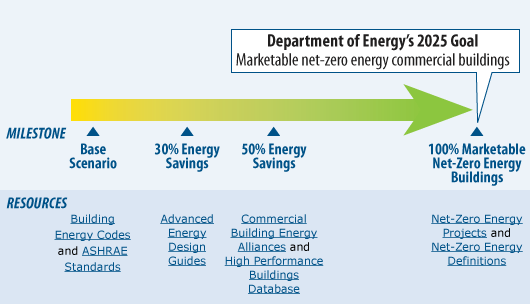
Net
Zero Energy
Net
Zero Energy Building
Pollution
Free Power
Rooftop
PV
Solar Energy Systems
Solar Power Parks
Solar Cogeneration
Solar Trigeneration
Synthesis Gas
Trigeneration
Waste
To Fuel
Wind
Power Generation
Wind
Power Technologies
_________________________________________________________
Renewable
Energy Institute
Contact us: info@RenewableEnergyInstitute.org
Renewable Energy Institute
Copyright © 2006
|